
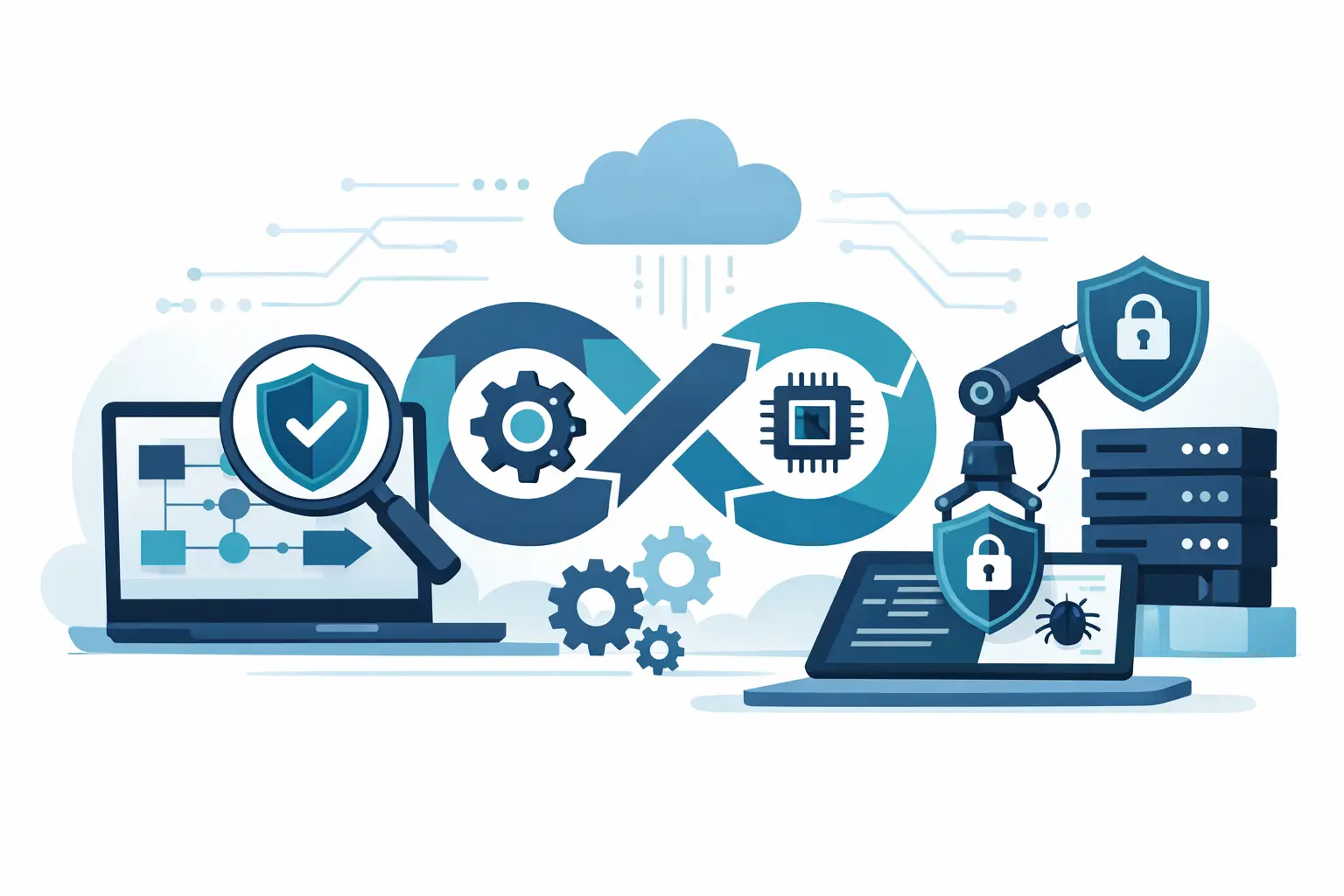
A pull request that passes functional tests but introduces a leaked credential, vulnerable package, or permissive cloud policy is not ready to merge. The practical answer is to automate security testing where engineering work already happens: in local development, pull requests, CI/CD pipelines, and deployment workflows.
Automation does not replace security review or threat modeling. It does make repeatable checks fast enough to run on every meaningful change, giving developers feedback before a small issue becomes a production incident. The goal is not to run every security scanner on every commit. It is to build a layered program that catches the right risks at the right point in delivery.
Start With the Risks You Can Test Repeatedly
Security testing covers several different problem types, and each requires a different signal. A static analysis tool can inspect application code for risky patterns, but it cannot reliably prove that an API’s authorization rules work as intended. A dependency scanner can flag a known CVE, but it cannot tell whether an exposed storage bucket violates your organization’s access policy.
Before choosing tools, map the systems you ship and the failures that matter most. For a typical web application, that may include source code, open-source packages, secrets, APIs, containers, infrastructure-as-code templates, cloud configuration, and runtime behavior. Teams working on payments, healthcare, or enterprise SaaS may also need stronger evidence for audit trails, data handling, and access controls.
This inventory helps prevent a common mistake: buying a broad security platform and enabling every scan without defining ownership or a response process. A finding that has no clear severity, assigned team, or remediation path quickly becomes background noise.
How to Automate Security Testing Across the Pipeline
Treat security checks as pipeline stages with clear purposes rather than one large security job at the end. Earlier checks should be quick and developer-friendly. More expensive scans can run on merge, nightly schedules, or release candidates.
Check code and secrets before a pull request
The earliest automated controls belong in the developer workflow. Pre-commit hooks and IDE integrations can scan for exposed API keys, private tokens, database passwords, and obvious insecure coding patterns. These checks are especially valuable because rotating a leaked secret is far cheaper before it reaches a shared branch, build log, or package registry.
Static application security testing, commonly called SAST, should also run in pull requests. Configure it to analyze the languages and frameworks your teams actually use, then focus its initial policy on high-confidence findings. For example, command injection, SQL injection, unsafe deserialization, path traversal, and hard-coded credentials are reasonable candidates for merge-blocking rules when the scanner can identify them reliably.
Do not fail every pull request over low-confidence style warnings. Developers will learn to bypass or ignore the system. Begin with issues that have a credible exploit path, then raise the bar as rules are tuned to your codebase.
Scan dependencies and build artifacts
Most applications contain far more third-party code than custom code. Software composition analysis, or SCA, identifies packages, their licenses, and known vulnerabilities. Run it whenever dependency manifests change, but also schedule recurring scans because new vulnerabilities can affect an unchanged build months later.
A useful dependency policy considers more than a CVSS score. Is the vulnerable component reachable by your application? Is there a fixed version available? Is the package used only in development tooling? Does the vulnerability affect a public-facing service? These questions do not eliminate urgency, but they help teams prioritize based on real exposure.
Generate a software bill of materials, or SBOM, as part of your build process. It creates an inventory of the components shipped in a release and supports faster incident response when a newly disclosed vulnerability affects a widely used library.
Test APIs and application behavior
SAST and SCA inspect what you build. Dynamic application security testing, or DAST, tests a running application. It can probe web routes, forms, headers, cookies, TLS configuration, and common injection weaknesses. Run DAST against a controlled staging environment after deployment, not against production unless the tool and test plan are specifically designed for it.
APIs need additional attention. Feed your scanner an OpenAPI specification where possible so it can discover intended endpoints, parameters, and authentication flows. Then add automated integration tests for business-level controls that generic scanners often miss: a user should not access another tenant’s records, an expired token must be rejected, and a support role must not perform administrator actions.
This is where security testing and quality engineering overlap. Authorization tests written alongside API tests are often more precise than a scanner because they encode the expected behavior of your product.
Secure containers and infrastructure-as-code
If your pipeline produces container images, scan them before publishing to a registry and again before deployment. Look for vulnerable operating system packages, unsafe base images, exposed secrets, root users, and unnecessary tools in the final image. Use minimal, maintained base images, but verify rather than assume they are safe.
Infrastructure-as-code scanning applies the same shift-left principle to Terraform, CloudFormation, Kubernetes manifests, and similar configuration. A pipeline can catch public object storage, unrestricted inbound rules, missing encryption, privileged containers, and overly broad IAM permissions before cloud resources exist.
Policy-as-code works well here because rules can be versioned, reviewed, and tested like application code. Still, infrastructure scanning should be paired with cloud posture monitoring. Templates may be secure at deployment, while later console changes or inherited settings create drift.
Create Gates That Improve Delivery Instead of Stopping It
A security gate is only useful if its behavior is predictable. Define what blocks a merge, what requires a ticket, and what can be accepted temporarily with documented approval. Severity alone is not enough. A critical vulnerability in a non-production test image may deserve a different response than a high-severity flaw in an internet-facing authentication service.
A practical model uses three paths. High-confidence issues with a clear fix block the pipeline. Findings that need context create a tracked ticket with an owner and due date. Accepted risks require an expiration date, compensating controls, and a record of who approved them. Exceptions without expiration tend to become permanent blind spots.
Baseline existing technical debt before enforcing new rules across a mature repository. Record current findings, prevent the count from growing, and reduce the backlog over time. This approach is usually more successful than breaking every existing build on day one.
Tune for Signal, Speed, and Ownership
Automation succeeds when developers trust the results. Measure false-positive rates, median time to remediate, scan duration, and the number of findings reopened after fixes. If a pull request scan adds 20 minutes, move slower checks to merge or nightly runs. If a rule produces repeated noise, tune it, suppress it with a documented reason, or remove it.
Assign ownership to the team that can fix the issue, while giving security engineers responsibility for policies, coverage, and escalation. Platform teams can provide reusable pipeline templates so every service receives baseline checks without each team rebuilding integrations from scratch.
Keep scanner configuration in version control. The rules enabled, severity thresholds, exclusions, and approved exceptions should be reviewable changes. That makes the security program easier to audit and less dependent on undocumented dashboard settings.
Validate the Automation Itself
Security tooling can fail quietly. A scanner may lose access to a repository, skip a new language, run against an outdated target, or report results that no pipeline gate reads. Test the controls periodically by introducing safe test cases, such as a deliberately invalid infrastructure policy in a non-production branch or a known sample secret that your platform recognizes.
Review coverage as the architecture changes. A move from virtual machines to Kubernetes, a new mobile client, or a growing set of public APIs changes the attack surface and should change the automated checks. The best program is not the one with the most scanners. It is the one that gives engineers timely evidence that each release meets the security expectations of the systems it touches.
Security automation earns its place when it becomes part of ordinary engineering judgment: a fast signal during development, a dependable guardrail in CI/CD, and a source of evidence when the business needs to ship with confidence.
